
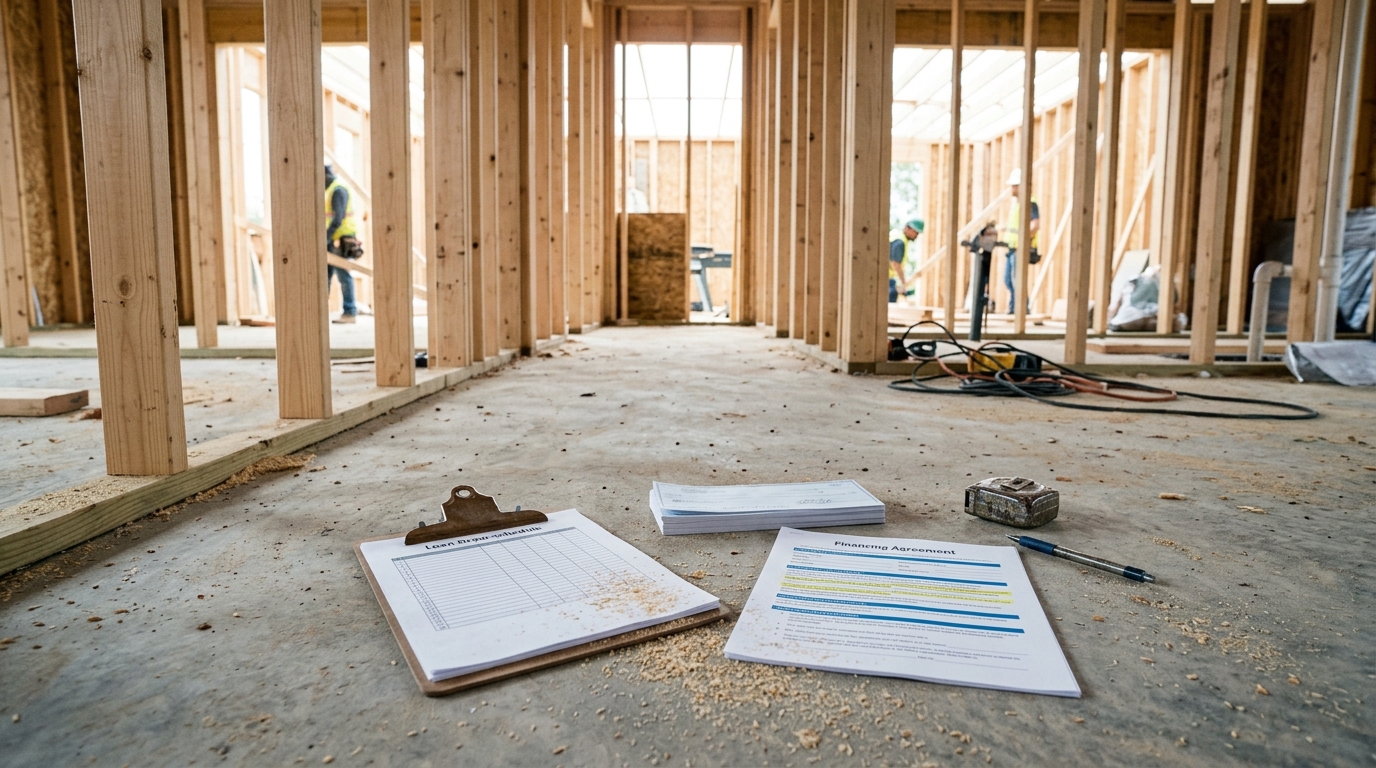
Ground-up construction projects routinely exceed budgets by 15%–30%, and the real culprits are hidden costs tied to new construction loans, compounding soft costs, and fees buried in financing agreements. Know these 7 line items before you close.
Ground-up construction projects routinely run 15%–30% over initial projections, and the culprit is almost never lumber or labor. The real budget killers are costs that experienced developers know exist but routinely underestimate: carrying costs on new construction loans, soft costs that compound during delays, and fee structures buried in ground-up construction financing agreements. Miss even two or three of the items below and your spec home financing can unravel before framing is complete.
Why Hidden Costs Hit Harder on Ground-Up Builds
Unlike a fix-and-flip, a ground-up construction project has a longer capital exposure window, typically 12–24 months from land close to certificate of occupancy. Every month of delay multiplies carrying costs against a loan balance that is growing through draw advances. Builder loans are also structured differently from conventional mortgages: interest accrues only on drawn funds, but as draws increase, so does the monthly interest burden. Developers who model only hard construction costs against a static loan balance routinely discover a $40,000–$80,000 gap at stabilization.
The 7 Hidden Costs You Must Line-Item Before Closing
1. Interest Reserve Burn on New Construction Loans
Most new construction loans require the lender to escrow an interest reserve at closing. That reserve is calculated against a projected draw schedule and a projected completion timeline. When projects run long (and most do), the interest reserve depletes before the project stabilizes. At that point, the borrower funds interest out of pocket. On a $2M construction loan at a 10.5% note rate with a 4-month overrun, the out-of-pocket interest exposure exceeds $70,000. Budget a 20% buffer above the lender's stated interest reserve requirement.
2. Draw Inspection and Administrative Fees
Every draw request on a ground-up construction financing facility triggers a third-party inspection. Inspection fees range from $300–$750 per visit depending on project size and geography. On a 10-draw schedule, that is $3,000–$7,500 in fees alone, none of which appear in the loan term sheet as a headline number. Add wire fees, draw processing fees, and title update endorsements (typically $150–$400 per draw), and the administrative load on a full draw schedule reaches $8,000–$15,000 on a mid-market project.
3. Permit and Impact Fee Escalation
Municipal permit fees and development impact fees are not fixed at the time you pull your initial feasibility numbers. Many jurisdictions update fee schedules annually, and impact fees for water, sewer, and traffic can increase 8%–18% in a single cycle. A spec home project permitted in Q1 may face higher fees than those quoted during due diligence six months prior. Budget impact fees at a 15% contingency above the current published schedule, and verify the schedule within 60 days of your anticipated permit submission date.
4. Soft Cost Overruns: Architecture, Engineering, and Surveys
Soft costs on ground-up builds typically run 8%–15% of total hard costs. Developers who cap their soft cost budget at the initial architecture contract routinely absorb unbudgeted invoices for structural engineering revisions, geotechnical reports required by lenders, boundary and ALTA surveys, civil engineering for grading and drainage, and energy compliance testing. Each of these line items looks small in isolation. Together they commonly add $35,000–$90,000 to a project that began with a $25,000 architecture contract.
5. Land Carry and Entitlement Costs Before the Construction Loan Closes
Ground-up construction financing does not typically close until entitlements are in hand and plans are approved. The period between land acquisition and construction loan close can run 6–18 months. During that window, the developer is paying interest on the land acquisition loan or carrying land equity at an opportunity cost, funding entitlement consultants, paying property taxes, and absorbing any HOA or special assessment obligations. Budget this pre-construction carry as a hard cost, not an afterthought. On infill urban lots, pre-construction carry of $60,000–$150,000 before a single shovel hits the ground is common.
6. Builder's Risk Insurance and Liability Premiums
Lenders require builder's risk insurance as a condition of builder loans. Premiums on ground-up construction are calculated on completed value, not current hard cost. On a $1.5M completed value project, annual builder's risk premiums range from $7,500–$18,000 depending on construction type, location, and flood zone designation. Projects in coastal markets or high-wind zones face surcharges that push premiums to 1.5%–2.0% of completed value annually. If your construction timeline extends beyond 12 months, you will pay at least one full renewal premium, which few initial budgets include.
7. Financing Extension Fees and Loan Modification Costs
Private and bridge lenders offering new construction loans typically write 12-month terms with one or two 3-month extension options. Extension fees range from 0.25%–1.00% of the outstanding loan balance per extension. On a $1.8M loan with a 6-month cumulative extension, the extension fee exposure is $4,500–$18,000, plus any retrade on the interest rate. Developers who project a tight 12-month build schedule without extension contingency are pricing in optimism rather than probability. Budget at least one extension and treat it as a baseline assumption, not a worst-case scenario.
How Ground-Up Construction Financing Structure Affects Every Line Item Above
The structure of your builder loan directly amplifies or mitigates each of the seven risks above. Loan-to-cost ratios, draw frequencies, and interest reserve methodology all interact. The table below compares the two most common structures developers encounter when seeking spec home financing from private lenders.
| Loan Feature | Monthly Draw Structure | Milestone Draw Structure |
|---|---|---|
| Draw frequency | Monthly, regardless of milestone | Tied to completion benchmarks (foundation, framing, etc.) |
| Inspection cadence | 12+ inspections on a 12-month build | 5–7 inspections total |
| Administrative fee exposure | Higher (more draw events) | Lower (fewer draw events) |
| Cash flow predictability | Predictable for GC scheduling | Dependent on inspection timing |
| Interest reserve accuracy | Easier to model | Can vary if milestones slip |
| Best suited for | Experienced builders with consistent subcontractor schedules | Developers with strong milestone documentation |
Practical Budgeting Rules for Developers Using Private Builder Loans
Apply these four rules before submitting a loan application for any ground-up project:
- Add 20% to lender-calculated interest reserves. Lenders model your timeline optimistically because they need the deal to pencil. You model it conservatively because you need the project to close profitably.
- Line-item every soft cost category separately. A single "soft costs" bucket is not a budget. Architecture, engineering, surveys, permits, impact fees, and entitlement consulting each need their own line.
- Price at least one extension into your pro forma. If you finish on time, the extension fee never gets paid. If you do not, you avoid a forced sale or a default.
- Verify insurance requirements with your lender before binding coverage. Some lenders require named insured endorsements or specific flood coverage thresholds that standard builder's risk policies do not include by default, triggering premium adjustments at binding.
Qualifying for Ground-Up Construction Financing Without W-2 Documentation
Private lenders offering new construction loans underwrite primarily on the asset and the developer's track record, not personal income documentation. A borrower with two or more completed ground-up projects, a fully executed GC contract, a detailed cost breakdown, and a credible exit strategy (sale or refinance into a DSCR loan) can qualify for ground-up construction financing without W-2s, tax returns, or debt-to-income analysis. The underwriting focus shifts to loan-to-cost (typically 80%–85% of total project cost), loan-to-ARV (typically 65%–70% of completed value), and the borrower's demonstrated ability to execute.
Ground-Up Construction Loan FAQ
What is a typical loan-to-cost ratio for ground-up construction financing?
Most private lenders offering ground-up construction financing advance 80%–85% of total project cost, which includes land, hard costs, and approved soft costs. Loan-to-ARV is typically capped at 65%–70% of the appraised completed value. The more restrictive of the two calculations governs the maximum loan amount.
Can I include land cost in my new construction loan?
Yes, if the land was acquired within the past 12–24 months and a current appraisal or broker price opinion supports the land value. Lenders advance against the lesser of the purchase price or appraised value. Land acquired years prior at a basis significantly below current market value may generate additional equity credit that increases your eligible construction advance.
How are draws processed on builder loans?
Draw requests are submitted to the lender with supporting documentation including invoices, lien waivers, and a construction progress update. The lender orders a third-party inspection to verify work-in-place. Upon satisfactory inspection, funds are wired to the borrower or directly to the title company. Processing time runs 3–7 business days per draw under standard conditions.
What happens if my construction loan expires before the project is complete?
You have three options: exercise a contractual extension (if available), negotiate a loan modification with your lender, or refinance into a new construction loan with a different lender. Extension fees apply in the first scenario. The third option triggers new origination costs and a fresh underwriting cycle. Avoid this situation by budgeting extension fees proactively and communicating schedule risks to your lender early.
Do private lenders offer spec home financing for first-time developers?
Some private lenders will consider first-time developers on smaller projects (typically sub-$750K total project cost) with a strong general contractor, a detailed budget, and a lower loan-to-cost request (70%–75%). Most lenders require at least one completed comparable project for loans above $1M. Pairing with an experienced co-borrower or guarantor who has a documented construction track record is the most effective path for a first-time developer seeking spec home financing on a larger project.