
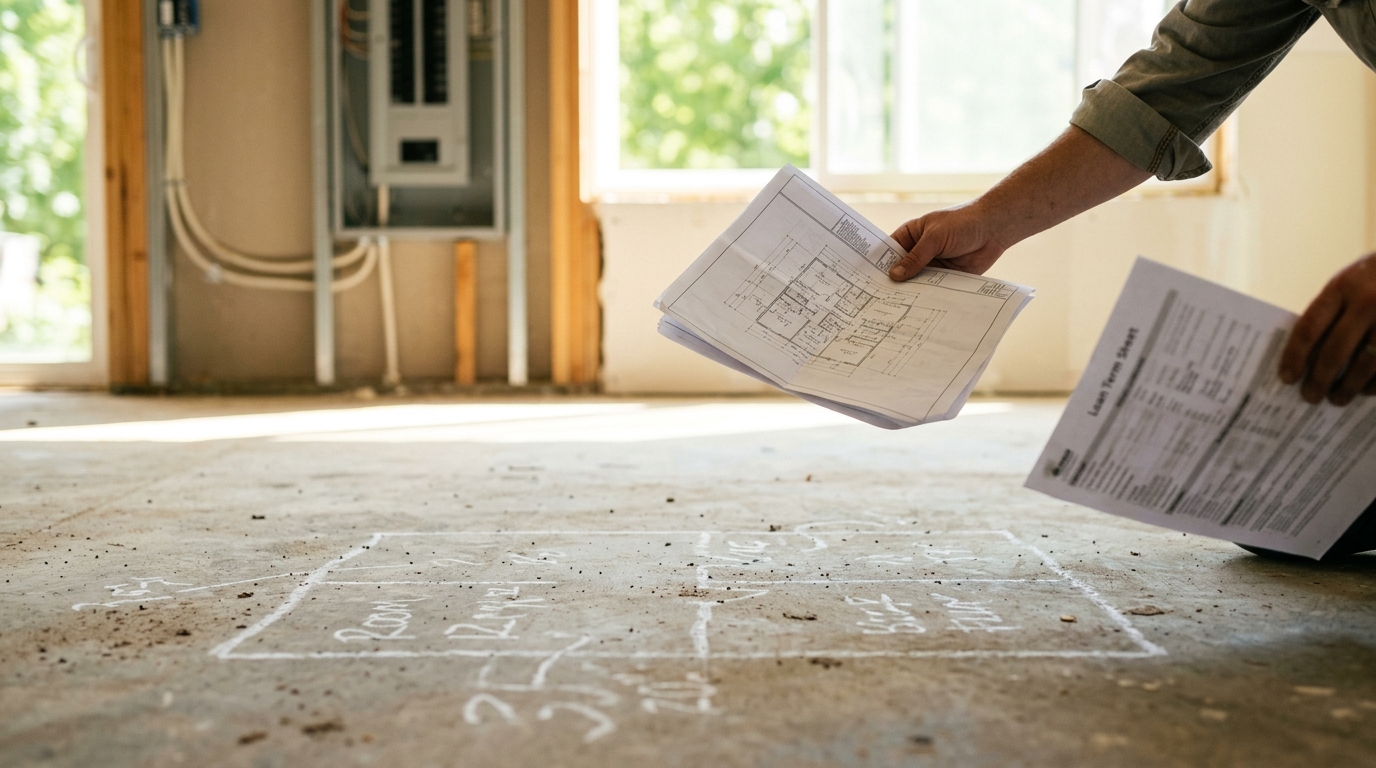
A cash-out refinance on an investment property lets you tap built-up equity without selling, putting six figures of working capital to work on your next deal. Learn the LTV limits, rate trade-offs, and deployment strategies investors use to scale.
Cash-Out Refinance on an Investment Property: Your Capital Recycling Engine
A cash-out refinance on an investment property lets you replace your existing mortgage with a larger loan, pocket the difference in cash, and deploy that capital into your next acquisition, renovation, or construction project, all without selling the asset. For real estate investors who have built equity in stabilized rentals or completed flips they decided to hold, this strategy is one of the most tax-efficient ways to access six figures of working capital without triggering a taxable sale event.
The mechanics are straightforward: if your rental property is worth $500,000 and you owe $200,000, most lenders will allow you to borrow up to 75% of the appraised value on a non-owner-occupied property, giving you a new loan of $375,000. After paying off the original $200,000 balance and covering closing costs, you walk away with roughly $155,000 in deployable cash. That capital can fund a down payment on a fix-and-flip, cover ground-up construction costs, or serve as the equity injection on your next DSCR loan.
Loan-to-Value Limits and Why They Matter More Than the Rate
Most conventional lenders cap cash-out refinances on investment properties at 75% LTV for single-family rentals and 70% LTV for two-to-four-unit properties. Portfolio lenders and private lenders sometimes push to 80% LTV, but they price that additional leverage into the rate and often add prepayment penalties to compensate for the risk.
Focusing only on the interest rate is the wrong frame. What actually determines the utility of a cash-out refinance is the spread between your current rate and the new rate, the equity you are extracting versus the equity you are leaving on the table, and the yield your redeployed capital will generate. If your rental carries a 4.5% note from 2021 and today's investment property cash-out rates are in the 7–8% range, refinancing the entire balance is expensive. In that scenario, a home equity line of credit or a second lien bridge loan against the property preserves the first mortgage and costs less in blended interest, even if the rate on the second position is higher.
DSCR Cash-Out Refinances: No W-2 Required
Investors who own their rentals in LLCs or who have complex tax returns that depress their reported income face constant friction with agency underwriting. DSCR (Debt Service Coverage Ratio) cash-out refinances solve this problem by qualifying the loan entirely on the property's rental income rather than the borrower's personal income. The lender divides the gross monthly rent by the proposed monthly debt service. A DSCR of 1.20 or higher typically qualifies at full leverage. A DSCR between 1.0 and 1.19 may still close, but expect a 5–10% reduction in maximum LTV or a rate premium of 25–50 basis points.
DSCR cash-out products are available for single-family rentals, condos, two-to-four-unit properties, and in some cases small multifamily up to ten units. Loan amounts typically range from $100,000 to $3 million, with a handful of lenders going higher for stabilized assets in liquid markets. Closing timelines run 21–35 days for a clean file, which is substantially faster than a conventional investment property refinance that routes through agency guidelines.
The Capital Stack: How to Deploy Cash-Out Proceeds Strategically
Extracting equity is only half the decision. Where the proceeds go determines whether the refinance was accretive or merely expensive. The highest-yield applications investors use regularly include:
- Down payment on a fix-and-flip with bridge financing: Most hard money bridge lenders require 10–20% of the purchase price plus rehab costs as the borrower's skin-in-the-game contribution. Cash-out proceeds from a stabilized rental are an ideal source because they are not tied to a specific property and arrive unencumbered.
- Equity injection for ground-up construction: Construction lenders typically require 20–30% of total project cost as borrower equity. Funding that requirement from a cash-out refinance rather than liquid reserves keeps savings intact as a liquidity buffer during the build.
- Acquiring additional rentals all-cash: Buying a distressed property all-cash, renovating, and then doing a DSCR cash-out to recapture most of the original capital is the BRRRR method (Buy, Rehab, Rent, Refinance, Repeat) executed at scale. The cash-out refinance is the step that reloads the magazine.
- Paying down or retiring a high-cost bridge loan: If you have an outstanding hard money loan at 11–13% on a stabilized asset, refinancing with a DSCR cash-out at a lower long-term rate and extracting equity simultaneously reduces carrying cost and frees up capital in a single transaction.
Tax Treatment: Why This Is Not Taxable Income
Loan proceeds are not income under U.S. tax law. When you extract $150,000 through a cash-out refinance, that $150,000 does not appear on your tax return as a taxable event. You have incurred a liability in exchange for the cash, so the IRS treats it as a wash. This is the structural advantage of debt-based capital recycling over selling the property, which would trigger depreciation recapture (taxed at 25%) and capital gains tax depending on your holding period and income level.
The interest you pay on the new, larger mortgage is generally deductible against rental income generated by the property, subject to passive activity loss rules and your entity structure. Consult a CPA who specializes in real estate to confirm treatment based on your specific situation, particularly if you hold properties across multiple LLCs or in a partnership structure.
Timing, Seasoning, and Common Underwriting Pitfalls
Most lenders impose a 6-month seasoning requirement before allowing a cash-out refinance. This means the property must have been titled in your name (or your LLC) for at least 180 days before the new loan closes. Some lenders enforce a 12-month seasoning period on properties acquired all-cash to prevent investors from inflating after-repair values immediately post-purchase. If you bought a distressed asset, renovated it, and are now refinancing within the first six months, expect to use the original purchase price plus documented renovation costs as the value basis rather than a fresh appraisal.
Additional underwriting friction points to resolve before applying:
- Lease documentation: Most DSCR lenders require a signed lease or a market rent analysis from a licensed appraiser. Month-to-month leases are acceptable at many lenders but may reduce qualifying rent by 10–15%.
- Entity vesting: Loans closing in an LLC typically require the LLC to be in good standing in its state of formation and, for some lenders, the state where the property is located. Have your articles of organization, operating agreement, and EIN letter ready.
- Insurance requirements: Investment property lenders require a landlord policy with the lender listed as mortgagee. Standard homeowner policies do not satisfy this requirement and will delay closing.
- Derogatory credit events: Many DSCR lenders allow cash-out refinances 2–4 years after a bankruptcy or foreclosure, with a maximum LTV reduction of 5–10% depending on the seasoning. Private portfolio lenders can close in as little as 1 year post-discharge if the loan is structured conservatively.
Cash-Out Refinance vs. Other Equity Access Methods
| Method | Max LTV (Investment Property) | Rate Type | Income Qualification | Best Use Case |
|---|---|---|---|---|
| DSCR Cash-Out Refinance | 75–80% | Fixed or ARM | Rental income only | Stabilized rentals, scaling portfolios |
| Conventional Cash-Out Refinance | 75% | Fixed or ARM | W-2 or tax returns required | Borrowers with strong documented income |
| Bridge Loan (Second Lien) | 65–70% CLTV | Variable or fixed short-term | Asset-based | Preserving low-rate first mortgage |
| Hard Money Refinance | 65–70% | Short-term fixed | Asset-based, no income | Post-foreclosure, credit-impaired borrowers |
| Portfolio HELOC | 70–75% CLTV | Variable | Varies by lender | Revolving access, multiple draws needed |
Investment Property Cash-Out Refinance FAQ
How much equity do I need to do a cash-out refinance on a rental property?
Most lenders require you to retain at least 25% equity after the cash-out, which means you can borrow up to 75% of the property's appraised value. On a property worth $400,000, the maximum new loan balance is $300,000. After paying off your existing mortgage and closing costs, the remainder is your cash proceeds.
Can I do a cash-out refinance on a property held in an LLC?
Yes. DSCR and portfolio lenders routinely close cash-out refinances in single-member and multi-member LLCs. The LLC must be in good standing, and most lenders require a personal guarantee from the principal members. Conventional agency products do not lend to LLCs, so DSCR or portfolio products are the primary path for entity-held properties.
How long does a cash-out refinance on an investment property take to close?
A DSCR cash-out refinance typically closes in 21–35 days from application with a complete file. Delays usually stem from appraisal scheduling, title issues, or missing entity documentation. Conventional investment property refinances through agency channels take 30–45 days on average.
Does a cash-out refinance affect my ability to qualify for future loans?
It increases your total debt load, which matters for lenders that underwrite on DTI (Debt-to-Income). However, DSCR lenders underwrite each property on its own cash flow, so additional debt on other properties has minimal impact on DSCR qualification. If you plan to grow a large portfolio, DSCR products decouple your borrowing capacity from your personal income statement.
What credit score is required for an investment property cash-out refinance?
DSCR lenders typically require a minimum 660–680 FICO for cash-out transactions at 75% LTV. Borrowers with scores between 620 and 659 can still qualify at reduced LTV (typically 65–70%) and with a modest rate premium. Private and hard money lenders can go lower, sometimes to 580, but reduce leverage to 60–65% and price the additional credit risk into a higher rate.