
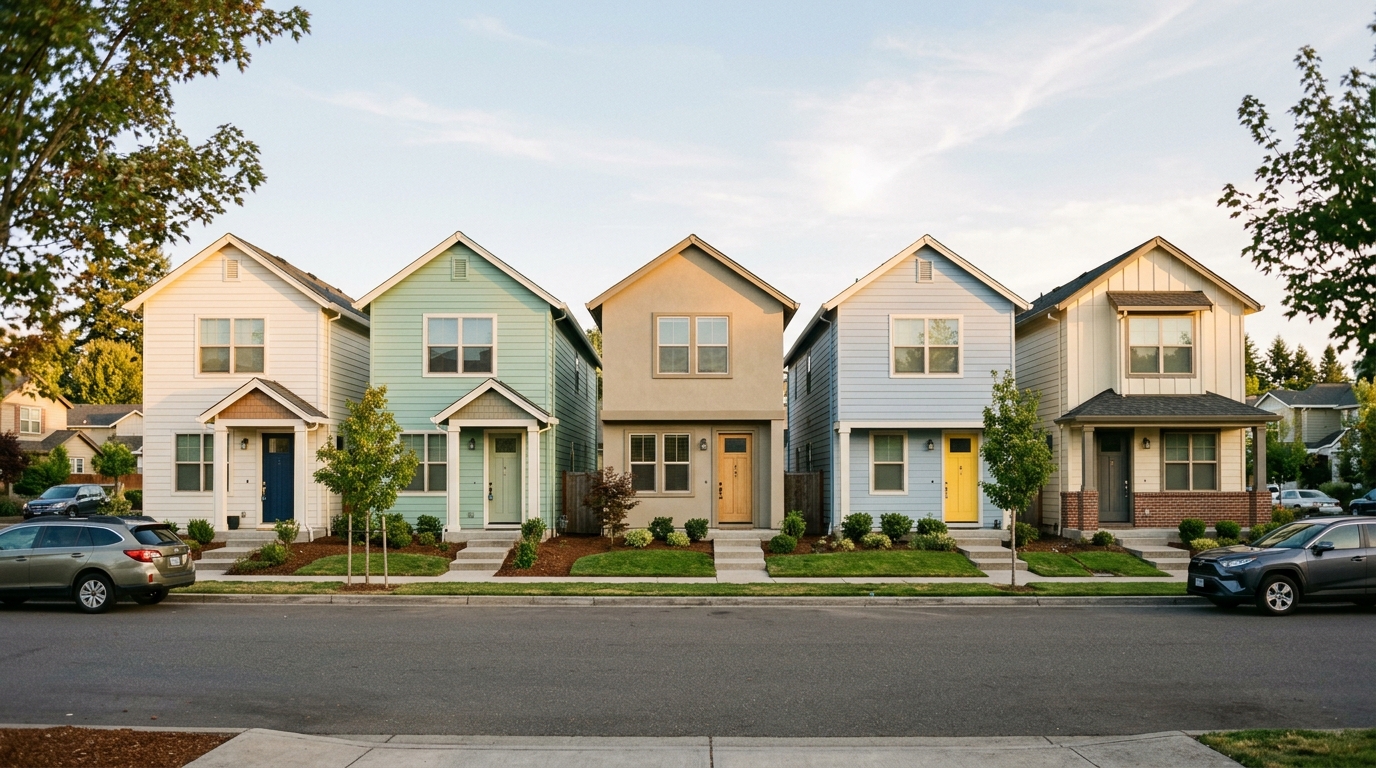
A blanket DSCR loan finances multiple rentals under one note, underwritten on pooled rental income instead of personal tax returns. Learn the requirements, DSCR math, and tradeoffs.
A blanket DSCR loan is a single mortgage that finances multiple rental properties under one note, underwritten on the combined rental income of the portfolio rather than the borrower's W-2 or tax returns. Most lenders require a portfolio debt service coverage ratio (DSCR) of 1.10 to 1.25, loan sizes from $750,000 to $20 million or more, and 5 to 10 properties as a typical minimum.
What a Blanket DSCR Loan Is and How It Works
A blanket mortgage places one lien across several properties. Instead of closing five separate loans with five sets of fees, appraisals, and payment dates, you close one. The lender underwrites the aggregate: total gross rents, less taxes, insurance, HOA dues, and sometimes a vacancy factor, divided by the total principal, interest, taxes, and insurance (PITIA).
The formula is simple: DSCR = Net operating income ÷ Total debt service. A portfolio generating $1,000,000 in annual rent with $800,000 in debt service has a DSCR of 1.25. Because the calculation pools every asset, a strong property can offset a weaker one that would fail a standalone DSCR test.
Because qualification rests on property cash flow, this structure works for self-employed investors, borrowers with heavy write-offs, and investors who hold properties in LLCs and cannot show conventional income. It is also a core tool among DSCR loan programs for long-term rentals.
Blanket Loan vs. Individual DSCR Loans: 6 Differences
| Factor | Blanket DSCR Loan | Individual DSCR Loans |
|---|---|---|
| Number of notes | One note, one payment | One per property |
| Closing costs | One set of title, legal, and lender fees | Repeated for every loan |
| Qualification | Pooled portfolio DSCR | Each property qualifies alone |
| Collateral risk | Cross-collateralized; default affects all | Isolated to one asset |
| Selling a property | Requires a release clause and partial paydown | Pay off that loan only |
| Typical minimum | 5–10 properties, $750k+ | Single property, often $100k+ |
The trade-off is clear. Blanket loans reduce friction and costs, but cross-collateralization concentrates risk. Individual loans cost more to originate but keep each asset ring-fenced.
When a Blanket Loan Makes Sense
Use a blanket loan in these situations:
- Consolidating existing debt. You hold 8 properties across different lenders with rates from 6.5% to 9.5% and varying maturities. One refinance simplifies servicing and removes balloon-date risk.
- Cash-out for the next acquisition round. Pooled equity across the portfolio can fund down payments on additional purchases without selling anything.
- Exiting short-term debt. Investors who finished renovations on several fix-and-flip or BRRRR properties can refinance them together into long-term rental debt instead of seasoning each loan individually.
- Buying a package. Acquiring 6 to 20 doors from a seller in a single transaction is often cleaner under one note.
Avoid a blanket structure if you expect to sell individual assets within the first 3 years, or if your portfolio contains one property with title, condition, or occupancy problems that could taint the whole package.
Underwriting Requirements to Expect
Terms vary by lender, but these are the standard benchmarks:
- Portfolio DSCR: 1.10 minimum at many lenders; 1.20 to 1.25 secures better pricing. Some programs allow DSCR at 1.00 with a rate premium.
- Loan-to-value: Up to 75% on purchases and rate-and-term refinances, 65% to 70% on cash-out.
- Credit score: 660 minimum, with the best pricing at 720 and above.
- Occupancy: Stabilized properties at 80% to 90% occupancy or better. Vacant units are underwritten at market rent from an appraiser's rent schedule (Form 1007).
- Prepayment penalty: Commonly a 5-4-3-2-1 step-down or 3-year fixed schedule. Yield maintenance appears on larger loans.
- Reserves: 6 to 12 months of PITIA on the pooled balance.
- Term: 30-year fixed, 5/1 or 7/1 ARMs, and interest-only options for the first 10 years.
Interest-only periods improve DSCR immediately, since principal is excluded from debt service. A portfolio at 1.08 on a fully amortizing basis can reach 1.30 or higher on interest-only terms. Confirm which calculation the lender uses to qualify you.
Entity Structuring for a Multi-Property Portfolio
Entity structure determines how much of your portfolio a single lawsuit or default can reach. Lenders typically require title to sit in an LLC or corporation, with a personal guarantee from the principals.
Three common structures:
- Single holding LLC. All properties sit in one entity. This is the simplest to close under a blanket loan, but a liability event at one property exposes every asset in the LLC.
- Series LLC. Available in states such as Texas, Delaware, and Illinois. Each series can hold one property. Some lenders and title companies resist series entities, so confirm acceptance before you form one.
- Parent holding company with property-level subsidiaries. A parent LLC owns several subsidiary LLCs, and the borrower is often a single-purpose entity holding the pooled collateral. This offers the cleanest liability separation but adds formation and annual filing costs in each state.
Practical rules: keep operating accounts separate per entity, carry umbrella liability coverage of $2 million or more, and never transfer title to a new entity after closing without lender consent, as most notes contain due-on-transfer clauses. Consult a real estate attorney in your state before forming anything.
Release Clauses and Substitution Rights: The Terms That Protect You
The most important negotiation point in a blanket loan is the right to sell or remove individual properties. Without it, you cannot sell one door without refinancing the entire note.
- Release price: Typically 110% to 125% of the allocated loan amount for that property. A $200,000 allocation at a 115% release price requires a $230,000 paydown to free the asset.
- Substitution of collateral: Lets you swap a property for another of equal or greater value and income, keeping the loan in place.
- Partial prepayment penalties: Confirm whether the penalty applies to the released portion only.
- DSCR maintenance test: Some lenders require the remaining portfolio to still meet minimum coverage after a release.
Negotiate these terms before signing. Releases are rarely added after closing.
How to Scale a Rental Portfolio with a Blanket Loan: A Step-by-Step Framework
- Audit the portfolio. Build a schedule showing each property's rent, taxes, insurance, current debt, balance, and estimated value. Identify properties with DSCR below 1.0.
- Order market rent data. Raise below-market leases to market at renewal before the appraisal where leases allow. Higher documented rent lifts coverage and loan size.
- Clean up title and entity records. Resolve liens, confirm entity good standing, and align ownership names with the borrowing entity.
- Model prepayment costs. Compare existing loan penalties against the savings from consolidation and the equity released.
- Choose a structure. Decide between cash-out and rate-and-term, fixed or interest-only, and the release terms you require.
- Redeploy proceeds. Use cash-out for down payments on the next acquisitions, then repeat the cycle once those assets stabilize. Keep post-closing portfolio DSCR above 1.25 to preserve refinance flexibility.
Operational Habits That Keep a Portfolio Loan Healthy
A single payment makes cash flow management easier, but it raises the stakes of operational slippage. Track vacancy monthly, because a loss of two or three units in a 10-property pool can push DSCR below covenant levels. Maintain a reserve account equal to at least 6 months of the blanket payment. Standardize leases, use professional property management at scale past roughly 15 doors, and calendar insurance and tax reassessment dates, since rising escrows reduce DSCR without any change in rent.
Blanket DSCR Loan FAQ
What is the minimum number of properties for a blanket DSCR loan?
Most lenders require 5 to 10 properties, though some programs start at 2 to 3 for loans above $750,000. Larger pools receive better pricing and higher leverage.
Can I get a blanket DSCR loan without W-2 income?
Yes. Qualification rests on property income, so no W-2s, tax returns, or employment verification are required. Lenders still review credit, reserves, and entity documents.
What DSCR do I need for a portfolio loan?
The common minimum is 1.10, and 1.20 to 1.25 earns the strongest rates. Interest-only structures can raise a marginal ratio into qualifying range.
Can I sell one property from a blanket mortgage?
Yes, if the note includes a release clause. Expect to pay 110% to 125% of that property's allocated loan balance, and confirm any prepayment penalty applies to the released portion only.
Is a blanket loan riskier than individual loans?
It carries more concentrated risk because all properties secure one debt. A default or covenant breach can affect the entire portfolio, so negotiate release and substitution rights and hold healthy reserves.